
Added an option for halovision devices where the headband used to be listed and the webcams / built-in cameras are listed.
Category: Software
Fixed a glitch when exporting multiple hours of EOG video data to the LSD format.
Made the stairway to heaven shorter again, the REM detection should be almost perfect now.
Added an option to export the video data from recordings with eye movements. It is off by default and the image files that will be exported can be seen if you right-click on an hour file and select “Open File Location”. There is a simple folder structure (/Hour/Minute/) that contains all the images that will be exported, and they can be pruned before export.
The LSD files can exceed 100 MB, especially if multiple hours are exported.
This also enables researchers to review sleep logs downloaded from the online database that are recorded in parallel with any of the other channels like EEG.

Ninja update: there is now also a “Save As GIF” option on the video player in the minute view.
Made the stairway longer to climb, but faster. This makes it more likely to trigger on rapid eye movements and less likely to trigger when settling down for the night. And added an extra filter to discard small movements that are within a second of large movements, as the ignore filter was sometimes being bypassed by small movements in the wake of large movements.
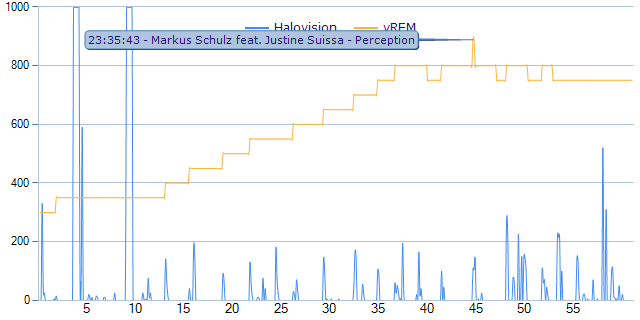
Added an “Ignore Percentage” filter variable to the algorithm. It ignores any movements that go over that amount of the video feed. So if it is set to 50% and more than half of the pixels have changed, it will ignore it. It defaults to 16% – anything more than that probably isn’t just the eyes moving during sleep paralysis…

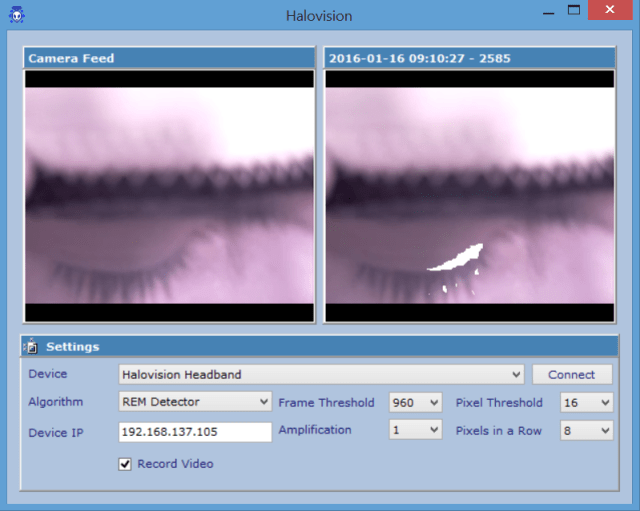
Added an option to record the video feed along with the Lucid Scribe Data files under \User\Documents\lucidcode\Lucid Scribe\Days\.
Made the program files path dynamic.

[Michael] has been working on projects involving lucid dreaming for a long time. The recurring problem with most projects of this nature, though, is that they often rely on some sort of headgear or other wearable which can be cumbersome to actually sleep with. He seems to have made some headway on that problem by replacing some of the offending equipment with a small camera that can detect eye movements just as well as other methods.
The idea behind projects like this is that a piece of hardware detects when the user is in REM sleep, and activates some cue which alerts the sleeper to the fact that they’re dreaming (without waking them up). Then, the sleeper can take control of the dream. The new device uses a small camera that dangles in front of an eye, which is close enough to monitor the eye’s movement. It measures the amount of change between each frame, logs the movements throughout the night and plays audio tracks or triggers other hardware when eye movements are detected.
[Michael] is looking for volunteers to provide sleep logs and run tests, so if you’re interested then check out the project!
Source: Hackaday

